What
We Promote:
Historical Models
Individual high-speed runs are nothing new but actually
date back to the late 1890's. The locomotive to exceed 100
mph was the New York Central and Hudson River RR no. 999.
On May 10, 1893 it while assigned to the Empire State Express,
it reached 112.5 mph while on a slight downgrade near Batavia,
NY. *
Other high-speed runs were conducted prior two World War
I. A notable record was a coast to coast run made via the
Atchison, Topeka and Santa Fe route for E. H. Harriman in
71.5 hours in 1906.
Regular operating at higher speeds came on the scene only
in the 1930's. The first out of the gate was the "Flying
Hamburger", which began operating between Berlin
and Hamburg, Germany on May 15, 1933. It was a diesel-electric
streamliner that covered the 178-mile route in 138 minutes.
In 1934 the German State Railway ordered 13 more two-car sets
which operated on routes radiating from Berlin.
The introduction of the Union Pacific M-10,000 and the Burlington
Zephyr in early 1934 represented a technological breakthrough
in train design. Both trainsets were "unit" trains
that used key design principals that allowed for safer operation
at higher speeds, while driving out operating, equipment maintenance
and track maintenance costs. The Zephyr is currently displayed,
with an excellent demonstration of its design principals,
at Chicago's Museum of Science and Industry.
Before being put into regular service, the Zephyr made a
high-speed run from Denver to Chicago in 13 hours. It covered
the 1015.4 miles in 13 hours 5 minutes, averaging 77.6 mph
and achieving a maximum speed of 112.5.
Not to be outdone, the Union Pacific M-10,001 set the yet
to be unbroken coast-to-coast record on October 22, 1934 by
running from Oakland Pier to Grand Central station in 57 hours
via the Union Pacific route. This train then went into service
as the City of
Portland, cutting the then best schedule time from Chicago
to Portland from 58 hours to 40 hours without any track upgrades.
These trains set off a wave of speed and quality improvements
throughout the country. Some were unit trains following the
principals embodied in the original streamliners. Other trains
achieved higher speeds through brute strength.
The Chicago to St. Paul/Minneapolis route is an excellent
example of the different approaches taken. By modernizing
an existing train and significantly upgrading the trackage
to prepare for operating speeds exceeding 100 mph, the Chicago
& NorthWestern was the first to get a new train into the
market on January 2, 1935. The train was marketed as the "400"
since it covered the roughly 400 miles in 400 minutes. It
was successful, not only in gaining market share, but also
in increasing total travel demand.
The Burlington Route introduced its Twin
Cities Zephyr on April 21, 1935. The two trainsets followed
the principals of the Pioneer Zephyr. They were also very
successful, but were too small. The railroad was unprepared
for the huge increases in ridership that resulted and two
new, larger trainsets were quickly ordered.
The second Twin Cities Zephyrs are thought to be the first
trains scheduled to travel faster than 100 mph.
The third entry into the market was the Milwaukee
Road, which built new, lighter, modern, conventional trains
for its Hiawatha. The locomotives were rebuilt, coal-fired
locomotives which were tested at speeds exceeding 120 mph.
Other railroads purchased unit trains, including the New
Haven's very successful "Comet",
the North Shore's "Electroliner"
and the Illinois Central's "Green
Diamond." Most, however, were unwilling to take the
risk of investing in the new technology and so upgraded existing
trainsets or built new, conventional trains. Significant speed
increases were possible with powerful steam locomotives. Streamlined
exteriors and modern interiors provided a marketing boost.
For example, the Pennsylvania Railroad designed a high-performance
trainset that would have made the Washington to New York run
in 3 hours and another for the Chicago to New York run. They
chose, instead, to take the more conservative route and rebuilt
existing cars to be pulled by the GG-1 in the east. For Chicago
to East Coast service they built the T-1,
capable of pulling a heavy, conventional train at 125 mph.
After WW II, most railways, including those in the US, re-equipped
their fleets with lighter, conventional trains with more amenities.
The US railroads misread the market and failed to redesign
their services to meet the new markets and built the wrong
types of trains. Railway patronage worldwide continued its
pre-war downward slide as travelers began switching to automobiles.
In most countries the railroad business returned to business
as usual (with less traffic) as the railroads got rebuilt.
The US suffered a significant setback when the Interstate
Commerce Commission created arbitrary speed limits based on
signaling technology. Though advanced signaling was expanded
in many areas, in most cases schedules were lengthened a result
of the limits. There is substantial evidence, however, that
trains continued to operate at speeds approaching or exceeding
100 mph until the speed limits were more closely enforced
in the mid-sixties.
There were several exceptions, however, including in Spain
where a new unit train was introduced, the Talgo. They were
built by American Car Foundry and delivered to Spain in 1949.
Because of their unique design, they were able to cut travel
times on the Madrid to Hendaye from 12 hours to 8 hours on
poor quality track. Their usage expanded dramatically in Spain.
Currently Talgos also operate in France, Germany, Kazakastan
and the US.
In the US, one railroad, the New York Central, did extensive
research into the passenger rail market. A new operating plan,
entitled "Travel Tailored Schedules" resulted from
their research. The new plan called for short, standardized
trains, operating on frequent schedules, with trains spaced
throughout the day.
The NYC also did extensive research into equipment design
which resulted in tests of three trains: The Talgo; The Aerotrain,
the design for which started out in the right direction, but
ultimately failed when General Motors insisted on using existing
bus parts, and the Explorer,
which ultimately lead to the United
Aircraft TurboTrain.
The NYC efforts were killed before they could bear fruit
with the death of their sponsor, NYC President Robert Young.
The new president Alfred Perlman recognized that a concurrent
program to reduce track capacity limited the ability to operate
frequent passenger service as well as the freight service.
He returned the practice of added passenger cars to mail and
express trains.
In France, the national railroad did several high-speed tests
and was the first to operate trains at 200 mph. This seemed,
however, to be just an exercise since they did not translate
the lessons learned into higher revenue speeds.
Japan was the first to present a new vision that bucked the
conventional wisdom that railroads had entered a permanent
state of decline. In May of 1957, the Railway Technical Research
Institute proposed building an entirely new railroad from
Tokyo to Osaka. The new railroad would reduce travel times
to 3 hours on the 342-mile route with a combination of technology
improvements and a straighter right-of-way.
The trainsets were essentially modernized conventional trains.
In fact, the World Bank, as part of the loan conditions, limited
speeds to 135 mph. The new right-of-way, which took the path
of a bullet, was the key to success.
The new trains began operating in the fall of 1964. This
is one of the very few examples of a new high-speed railroad
being built completely separate from the existing network.
Additionally, it is important to point out that the existing
narrow gauge services continued to provide local service.
The successful implementation of Japan's bullet trains spurred
three countries to action. In the US, the High-Speed Ground
Transportation Act of 1965 created the Office of High-Speed
Ground Transportation (OHSGT). One of its charges was to create
3-hour service from Washington to New York and from New York
to Boston.
This resulted in the "Metroliner" which used the
"brute strength method" of modern conventional trainsets
on existing infrastructure. While the "Metroliner"
set no speed records, it was successful in being implemented
quickly and being a commercial success.
For the north end of the corridor, the Department of Commerce
took the other approach. It ordered two TurboTrains from United
Aircraft for the New
York to Boston service. These unit trains were, in essence
the next generation Explorer, and resulted from decades of
study into effective train design. While the trainset itself
was a huge leap in technology, institutional hurdles prevented
it from reaching its potential. A Canadian version was operated
successfully on the Montreal to Toronto corridor until the
early eighties.
Beginning in April 1967 the French tested experimental turbine
powered trains made over 432 tests at speeds. In 1968 they
successfully implemented a new high-speed turbo-train service
on the Paris-Caen-Cherbourg route on an existing right-of-way.
The new trains cruised at 180 kph and resulted in a travel
time reduction of 45 minutes to 3 hours. A new operating plan
consisting of more frequent service and affordable fares was
a crucial component of success.
In 1969 two prototypes for the next generation turbos were
ordered. Dubbed TGV01 and TGV02, they were intended for very
high speeds on dedicated rights of way. The TGV01 was a very
lightweight, unit train which established the now standard
of a maximum weight of 17 tonnes per axle. This low weight
is crucial for maintaining reasonable operating and maintenance
costs.
1972, TGV01 reached 300kph. This test convinced SNCF that
frequent, high-speed service on a dedicated right of way was
possible. Subsequent TGV's were electrically powered as a
result of the energy crises.
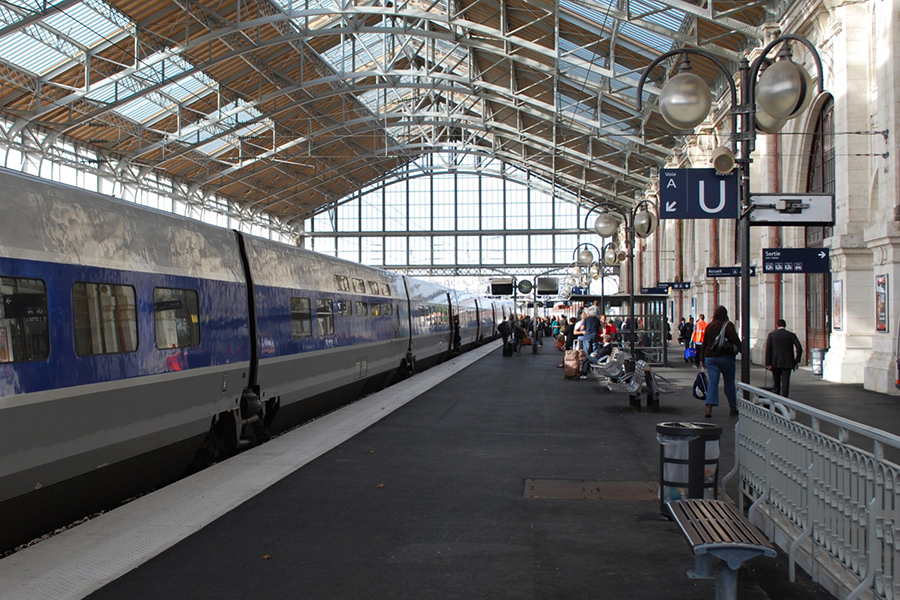
On September 22, 1981 commercial service between Paris and
Lyon was launched. At the opening only two thirds of the new
route was complete, but the new trains saved 67 minutes in
travel time. As new trainsets became available, service was
extended beyond Lyon. Because of their design, the new trainsets
allowed travel time improvements and service levels for many
destinations, despite only travelling on dedicated rights-of-way
for a portion of the trip. Even today, only one third of the
TGV network is operated on dedicated track.
With the TGV, the French succeeded in combining the advantages
of new rights-of-way with superior train design to create
a superior product for many markets.
|